Celebrating the “Little Things that Run the World”
by Anna Twigg, ACWA Board Member
Did you know that the final week in June is World Insect Week? Last month, June 22-28 was earmarked to celebrate insects and entomology, the study of insects. While it’s nice to have the extra recognition, our native insects are certainly worth celebrating all year round. Let’s talk about why.
You might not be too fond of insects when you find them in your house or when they're crawling up your arm. I’ll admit that I myself like to appreciate most insects from afar. That said, there’s no denying that insects are an essential part of our beloved ecosystems and food webs. Without insects, life as we know it would be irreparably changed, and not for the better. E.O. Wilson, a famous and celebrated Naturalist, once called insects “the little things that run the world.” (resource link), and my goodness, he was right! More recent research by Dr. Doug Tallamy reveals just how much our ecosystems rely on an abundance and diversity of native insects. To learn more about Dr. Tallamy’s research, check out some of his books or some of his posted research.
A Special Guest:
My partner and I volunteered with ACWA to run a booth at the Master Gardener’s Pollinator Palooza event in mid-June. We set up a tree ID activity using potted plants from ACWA’s volunteer nursery, and had some educational pamphlets to hand out about our beautiful watershed. Folks who visited the ACWA booth could not only work on their tree ID skills, but they could rank each of our demonstration trees in terms of how they support pollinator biodiversity (resource link). Four native woody plants were showcased at the ACWA booth during Pollinator Palooza, including white oak, red maple, eastern white pine, and spicebush. Pretty early on, we noticed some very special visitors on our potted spicebush plant… not one, but TWO early instars of a Spicebush Swallowtail Butterfly (resource link)!
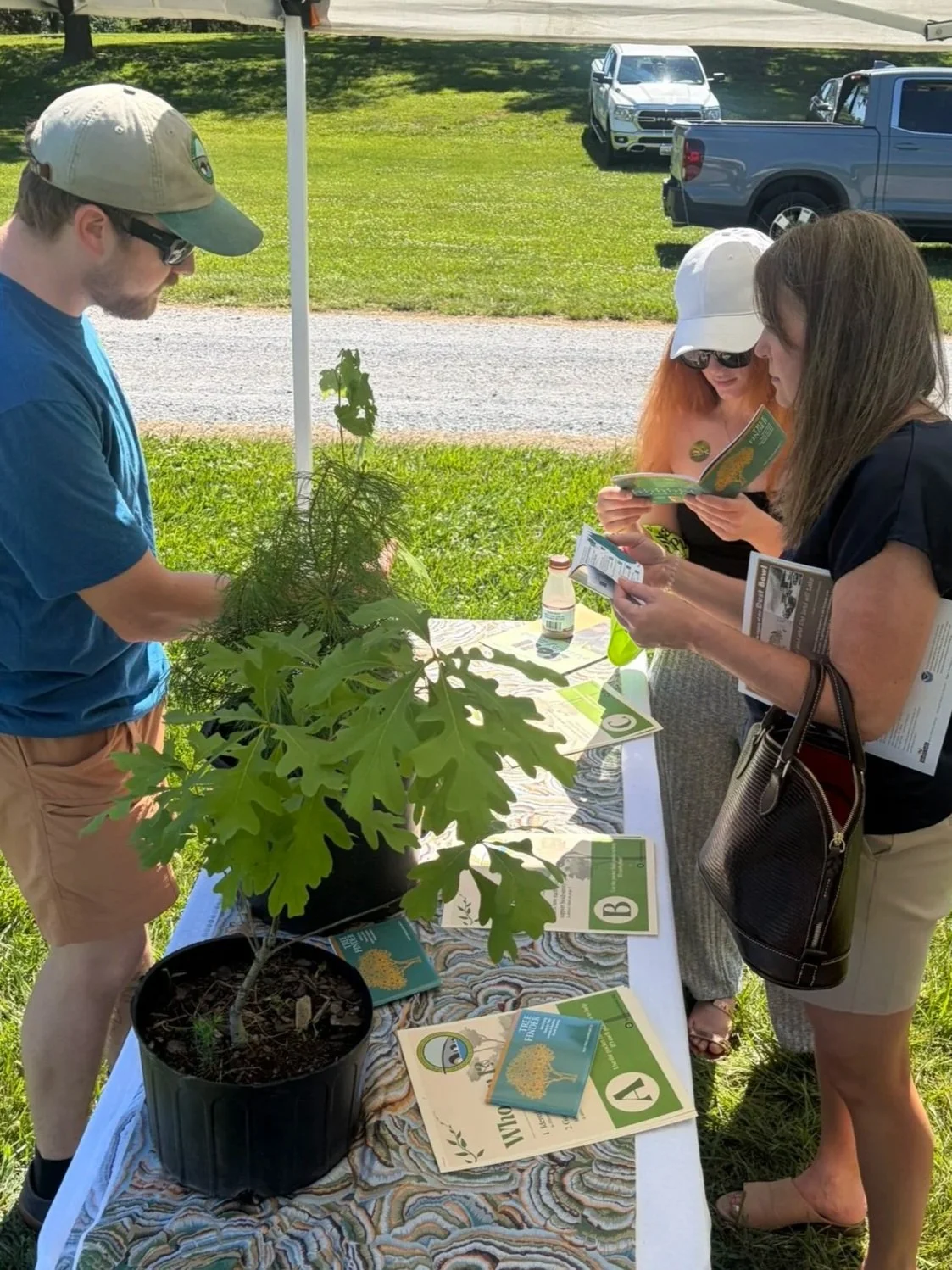
ACWA Board Member Ben Tucker (left) helps visitors with a hands-on activity at Pollinator Palooza 2026.
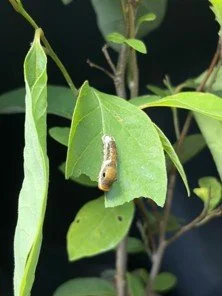
Early instar Spicebush Swallowtail caterpillar, photo by blog author: A. Twigg.
These little caterpillars stole the show (and our hearts) during the Pollinator Palooza event. Guests were able to see the young caterpillars weave silk on their favorite spicebush leaf and create a little hideout, from which they would emerge to munch on other leaves of the plant. Not only does this charismatic little caterpillar turn into a stunning native butterfly; they also have a rather unique camouflage adaptation. In their early instars, the caterpillars mimic fresh bird droppings. This disguise makes them less appetizing to any birds or predators looking for a meal, as shown in the adjacent photos.
My partner and I were so enamored by the caterpillars that we took the potted spicebush plant home where we could better monitor their development. The two hungry caterpillars quickly defoliated the small potted plant. Thankfully, we had planted 2 spicebushes from the ACWA nursery earlier this spring, so we placed the potted plant near our existing spicebush so the little guys would have plenty of food. We made it a part of our daily routine to walk up and check on our newest more-than-human neighbors, and it was incredibly rewarding to watch them grow. It was particularly rewarding to know that the caterpillars were directly benefitting from the spicebush plants that we planted on our property. Before this spring, we didn’t have any spicebush in our immediate area, and we likely would not have seen the charismatic caterpillars as a result. Because we are working to introduce more native plants and enrich the local biodiversity of our area, our home is better able to be a home to local wildlife.
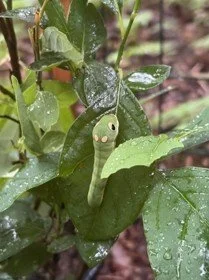
Late instar of the spicebush swallowtail caterpillar.
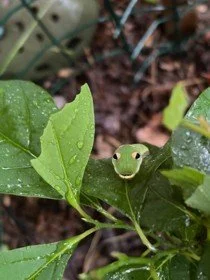
Later instar biomimicry with spots that mimic large eyes.
Later instars of the spicebush swallowtail caterpillars shift to a different kind of biomimicry. Our little visitors turned green and began to mimic a tree snake! The markings in their back are designed to mimic the eyes of a snake. When prodded, the caterpillars even sprout bright orange horn-like “osmeterium” to repel predators. There’s a theory that their osmeterium are meant to mimic a snake’s tongue. This expert disguise will make any hungry predator think twice before approaching. See photos of the snake-like caterpillar - taken just 5 days after we first discovered the early instar on the potted plant.
The spicebush swallowtail caterpillar undergoes a remarkable transformation during its final two life stages. After the caterpillar spins silk to secure themselves to a twig, they form the chrysalis that mimics a living or dead leaf. This final stage of expert camouflage protects the caterpillar before it emerges as an adult butterfly. The spicebush swallowtail butterfly is a gorgeous butterfly with large, velvety black-brown wings. The bottom of the hindwings feature vibrant blue-green coloration and the wings are bordered with pale spots. Chances are, you have seen this type of butterfly flutter by!
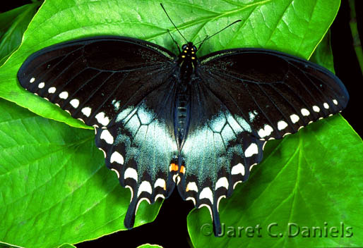
Spicebush Swallowtail butterfly, photo credit Jaret C. Daniels
Suffice it to say, these two little caterpillars had us pretty amped up. Sometimes the state of our natural world can induce feelings of doom and gloom. It means a lot to see restoration in action, even if it’s “just” a couple of caterpillars. The fact that we as individuals could create habitat that supports wildlife at our property is incredible. Even more incredible is the immense, tangible impact that ACWA’s volunteer-run native tree and shrub nursery continues to create. Our local wildlife is already utilizing the native plants while they are being tended in the ACWA nursery; and wildlife will continue to benefit from the plants when they are purchased and planted across our watershed.
When I brought up the idea of writing this blog, fellow ACWA members jumped at the opportunity to share their own experiences with native caterpillars. Our organization’s President, Susan Simonson, shared a photo of a Cecropia Moth caterpillar, which she found at the ACWA plant nursery. This colorful caterpillar looks like something out of a Dr. Seuss book, and will grow into North America’s largest native moth. Just take a look at the spiky, neon polka dots on this little guy. This caterpillar was found munching on a southern crabapple at the ACWA nursery. How can you not love that?
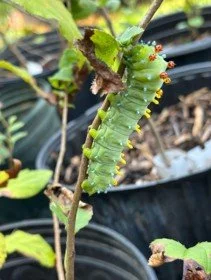
Cecropia Moth caterpillar at ACWA Nursery
Perhaps a more familiar caterpillar is that of the Monarch butterfly. You might be familiar with the host plant relationship between Monarch butterflies and milkweeds, a native herbaceous perennial wildflower. Monarch caterpillars can only eat the leaves of milkweeds, and Monarch butterflies will only ever lay their eggs on the leaves of plants in the milkweed genus. Without milkweeds, there would be no Monarchs. When people noticed the drastic declines in Monarch butterfly populations, groups around the eastern US rallied to plant milkweeds to increase their habitat. Many of these plantings morphed into Monarch waystations or diverse plantings of milkweeds and other native wildflowers designed to create habitat and food sources for monarchs and other pollinators. This widespread community action to support the Monarchs is an excellent example of seemingly small-scale restoration making a large-scale impact. It makes sense that people see and understand the connection between pollinators and wildflowers. After all, those plants are often more accessible and are close to the ground, or eye-level.
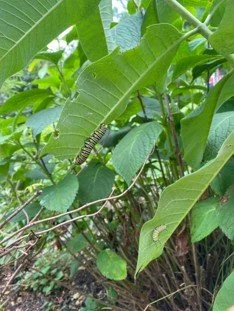
Monarch caterpillar on Common Milkweed
You might be surprised to learn, then, that woody plants like native trees and shrubs generally play a much larger role in supporting pollinators than our native wildflowers. Entomologist Dr. Doug Tallamy researched the role native plants have in supporting the life cycles of moths and butterflies, and he published a list of the top 20 herbaceous perennials/wildflowers and the top 20 woody-stemmed plants (resource here). The top-ranked wildflower is goldenrod, or plants in the Solidago genus. Goldenrods support 104 different species of moths and butterflies. The top-ranked woody plant is oak, or plants in the Quercus genus. Oaks support a whopping 557 species of moths and butterflies. In fact, the top-ranked wildflower, goldenrod, is still surpassed by the 20th ranked woody plant, which is chestnut (127 species supported). Let me clarify that this number of species supported does not mean that a moth or butterfly simply visited these plants for a nectar source. This number indicates that many species of moths and butterflies need that particular plant to complete their life cycle. I am by no means telling folks to stop planting native wildflowers. They play a vital role in supporting native insects! However, next time you want to do something to support the pollinators, consider adding trees and shrubs to your plan. Why not plant an oak tree along with your goldenrods? Just some (caterpillar) food for thought.
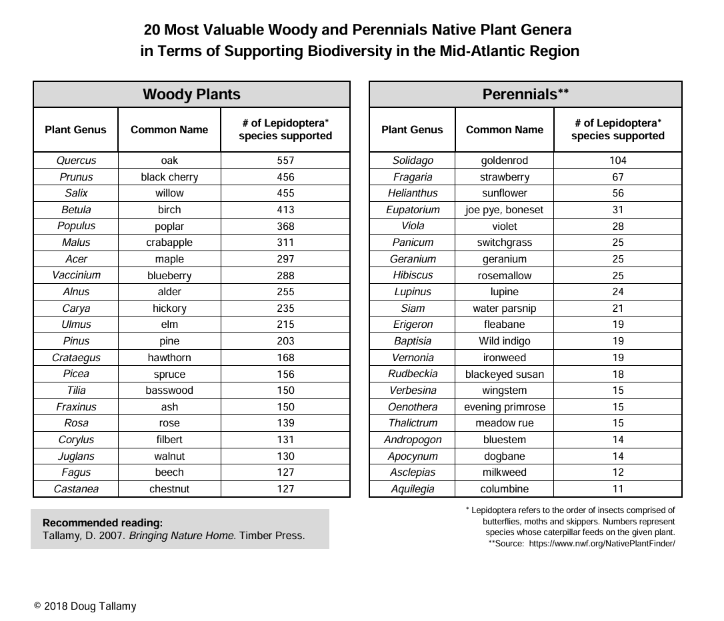
20 Most Valuable Native Plant Genera supporting Biodiversity in Mid-Atlantic Region, D. Tallamy, 2018 https://canr.udel.edu/wp-content/uploads/sites/16/2018/10/30121131/20-Most-Valuable-for-Biodiversity.pdf
The thing is, host plant relationships between insects and plants are generally the rule, not the exception. The vast majority of our native insects are highly specialized and rely on particular plant genera, or sometimes even one specific species within a genus, in order to complete their life cycles. These insects and plants have co-evolved over thousands of years. Without the host plant, the insect would not exist. For example, without spicebush shrubs (or sometimes sassafras trees), our little spicebush swallowtail caterpillars could not exist. The state butterfly of Maryland, the Baltimore checkerspot, relies on the white turtlehead plant to complete their life cycle (resource here). Some host plants need particular insects to pollinate them, or they will never be able to reproduce. Our ecosystems absolutely rely on native plants, but not all native plants are necessarily equally hard-hitting when it comes to supporting insect biodiversity. A study revealed that in the eastern United States, over 90% of our native caterpillars rely on just 14% of native plant genera to complete their life cycles (article here). If you are interested in learning more about host plants or keystone species, check out these resources to learn more.
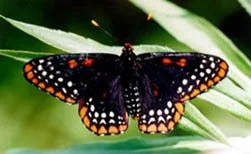
Baltimore Checkerspot Butterfly. Photo by Mark S. Garland, Audubon Naturalist Society.
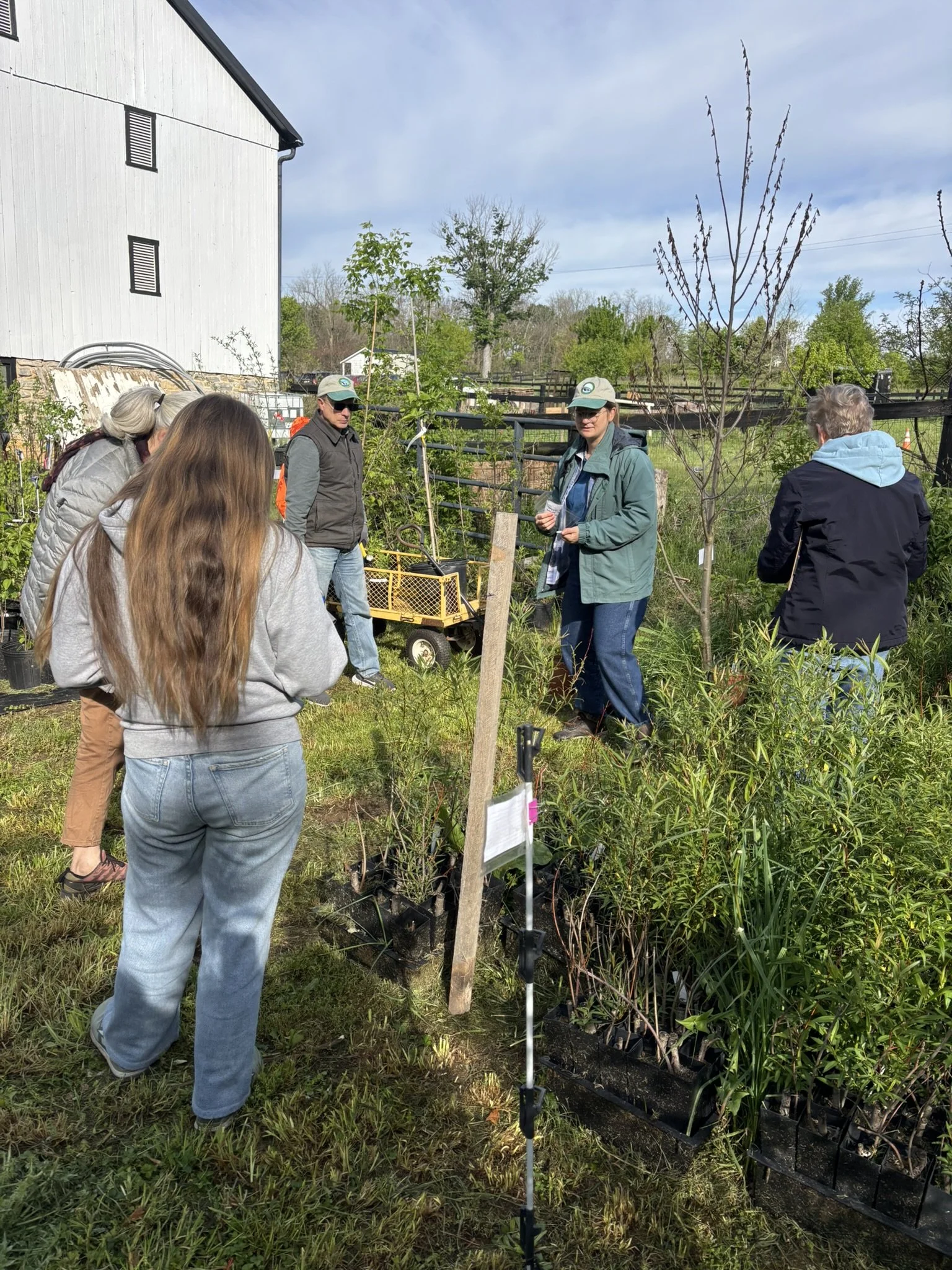
Blog author Anna Twigg, right, assists shoppers at an ACWA Nursery sale
The critical link between native plants and native insects is just one of the many, many reasons that our ACWA volunteers started a tree and shrub nursery back in 2024. We are committed to playing an active role in restoring our watershed’s health, and that means restoring habitat with native plants and bringing balance back to ecosystems. Be a cater-PILLAR of our natural community, and plant some native trees! We hope to see you at the next nursery plant sale on October 3rd, 2026.
Take Action:
In general, things aren’t going too well for our native insects. Habitat loss, habitat fragmentation and degradation, climate change, drought, widespread and heavy-handed pesticide use, and more stressors are causing once-common species of insects to be on the brink of extinction. Many once widespread species of insects are already locally extinct or "extirpated" in some parts of the Eastern U.S.. Spoiler alert: this should concern you. Much of the land we live on is no longer supporting the rich diversity of life that it once did. Humans are certainly part of the problem, and we must be part of the solution.
You might not think that what you, one person, does on your property makes much of a difference, but it does. What you do can help, and it can harm. Take action! Take action at home, and take action in your community. Encourage your municipality, place of worship, school, business, etc. to prioritize planting native plants and restoring habitat. Remove the non-native or invasive plants from your property and replace them with keystone native plants. Learn more about how to take action online at Dr. Tallamy’s “Home Grown National Park” website (resource link).
Quick tips for becoming a PILLAR in the Caterpillar Community:
Fewer Lights at Night can Keep the Bugs in Flight! Light pollution causes significant stress to insects. Nocturnal pollinators like moths are attracted to outdoor lights. Flying around these lights causes insects to expend precious energy stores. Flying toward the light also makes them more visible to predators (resource link). If you must keep a light on at night, make the switch to a yellow-toned bulb and add a cap to your bulb to direct light downward. Better yet, make that yellow bulb motion-sensing so it only comes on when you truly need it.
Fog-off with that Mosquito Fogger! Listen, we don’t like mosquitoes either. The huge uptick of mosquito populations are a result of ecosystems that are out of balance. Broadcast spraying pesticides that kill other insects, including caterpillars and mosquito predators like dragonflies, is not a sound way to restore that balance (resource link). Mosquito fogging companies claim that their treatments only target mosquitoes. That is simply not true. Want to control mosquitoes in a more natural and less harmful way? Learn more here (resource link).
Remove & Replace Invasive Vegetation! Non-native invasive plants (NNIs) are wreaking havoc on natural habitats. NNIs outcompete native plants and offer little to no value to our local wildlife. They do not support the life cycles of moths and butterflies. Some species, like garlic mustard, are actually directly linked to the decline of native butterflies. Remove those pesky NNIs, and replace them with keystone native plants. Learn more about non-native invasive plants at ACWA’s workshop coming up on August 22. Check out the event info here.